


How can the ash and slag treatment system of an integrated wood burning stove be designed to be more convenient and efficient?
Release Time : 2025-12-03
The ash and slag treatment system for an integrated wood burning stove needs to balance convenience and efficiency. Its design should revolve around the stages of ash and slag discharge, collection, transportation, treatment, and resource utilization. Through modular design, automated control, and environmental technology optimization, the system aims to achieve the harmlessness, reduction, and resource recovery of ash and slag. The following analysis focuses on three aspects: system composition, technical approach, and innovation direction.
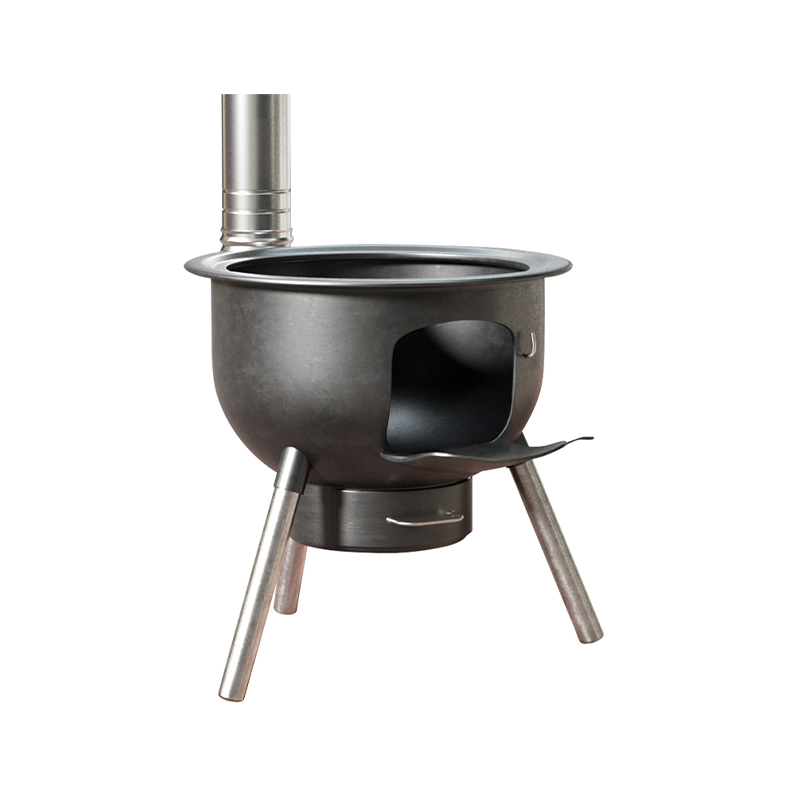
The discharge and collection of ash and slag from an integrated wood burning stove is the starting point of the treatment system. The ash and slag produced after combustion in an integrated wood burning stove must be efficiently discharged through the ash discharge port to prevent accumulation in the furnace and its impact on combustion efficiency. A hydraulic pusher-type ash remover can be used in the design. Hydraulic power drives the pusher head to reciprocate, pushing the ash and slag from the ash discharge port into the ash remover chamber. The chamber is water-cooled, using circulating cooling water to reduce the temperature of the ash and slag, preventing oxidation or spontaneous combustion of the high-temperature ash and slag, while ensuring isolation between the furnace and the outside environment to prevent heat loss. Wear-resistant plates can be laid on the inside of the ash remover to extend the equipment's service life; a level controller is installed to automatically adjust the cooling water flow rate according to the amount of ash and slag, achieving a balance between water conservation and cooling effect.
The ash conveying process needs to balance efficiency and stability. Ash discharged from the ash remover needs to be transported to the ash pit or subsequent processing equipment, which can be achieved using a combination of chain bucket conveyors and submerged scraper conveyors. Chain bucket conveyors are suitable for long-distance transport of coarse ash; their chain bucket structure prevents ash from scattering and ensures continuous transport. Submerged scraper conveyors are used for transporting fine ash; their enclosed structure prevents dust generation, and the scrapers propel the ash forward for efficient transport. A buffer silo can be installed between the two conveyors to balance the ash flow and prevent equipment jamming due to flow fluctuations.
Screening and magnetic separation of ash from integrated wood burning stoves are key steps in improving resource utilization. Ash often contains unburned carbon particles, metallic substances, and particles of different sizes, requiring grading by a drum screen. The screening machine is equipped with multiple layers of screens to separate ash slag into three grades: coarse, medium, and fine. Coarse ash slag can be directly used for road paving or building material preparation; medium ash slag can be returned to the furnace as supplementary bed material to improve combustion efficiency; and fine ash slag requires further processing. The screened ash slag needs to be separated by a metal magnetic separator to remove magnetic substances such as iron and nickel. These substances have high recycling value and can be sent to metal recycling plants for reuse. The magnetic separator uses a strong magnetic field design to ensure thorough metal separation and reduce resource waste.
Solidification and stabilization of ash slag are important means of reducing environmental risks. Ash slag may contain harmful substances such as heavy metals, which need to be fixed through solidification technology to prevent leachate from polluting soil and water sources. Cement solidification is one common method, where ash slag and cement are mixed in a certain proportion, and an appropriate amount of water is added and stirred to form a solidified body. Cement hydration products can coat ash slag particles, reducing the migration of heavy metals. The solidified ash slag needs to undergo strength testing to ensure that its compressive strength meets landfill or resource utilization standards. For ash slag with high heavy metal content, chemical stabilization technology can be used. By adding chemical reagents such as sodium sulfide and phosphoric acid, the heavy metals can be converted into insoluble compounds, further reducing their environmental risks.
Resource utilization of ash slag is the ultimate goal of the system design. Treated ash slag can be widely used in construction, road construction, and agriculture. For example, coarse ash slag can be used as concrete aggregate or brick raw material, replacing some natural sand and gravel and reducing construction costs; fine ash slag can be used to produce insulation materials or ceramic products, improving product performance. Ash slag can also be used for soil improvement; its potassium and phosphorus content can enhance soil fertility and improve soil structure. The design should establish a cooperative mechanism with downstream enterprises to ensure stable sales channels for ash slag, forming a closed-loop industrial chain of "generation-treatment-utilization".
Automated control is the core of improving system convenience. A PLC control system integrates equipment at each stage, realizing automated operation of processes such as ash slag discharge, conveying, screening, magnetic separation, and solidification. The system can be equipped with a real-time monitoring module to monitor ash slag quantity, equipment status, and environmental parameters. When an anomaly occurs, an alarm is automatically triggered and an emergency response procedure is initiated. For example, when ash and slag accumulate too high in the slag remover, the system can automatically adjust the movement frequency of the pusher to accelerate the slag discharge speed; when the screen of the screening machine is clogged, the system can issue a cleaning prompt, reducing the frequency of manual inspections.
Environmental protection measures are the bottom line requirement of the system design. Dust, wastewater, and noise pollution may be generated during ash and slag treatment, requiring targeted prevention and control measures. For example, spray devices can be installed at conveyor transfer points to absorb dust through atomized water droplets; exhaust gas treatment equipment can be installed in the curing workshop to collect and treat dust generated during the curing process; silencers or soundproof covers can be installed on high-noise equipment to reduce noise propagation. Simultaneously, an environmental emergency response mechanism must be established, and contingency plans for emergencies such as ash and slag leakage and equipment failure must be developed to ensure that the system operation complies with environmental standards.