
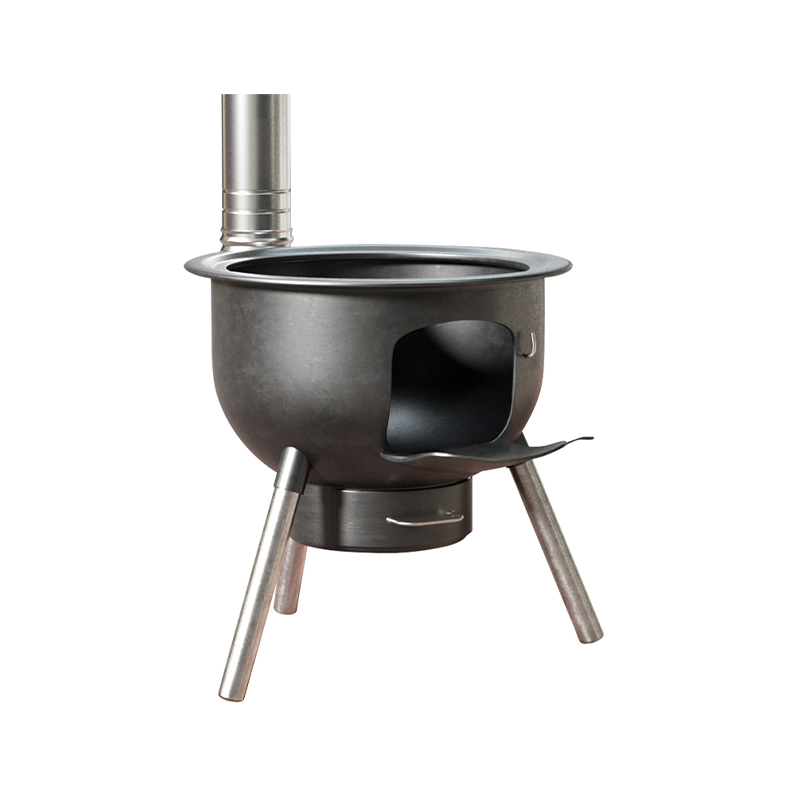


How does the air inlet design of an integrated wood burning stove specifically affect combustion performance?
Release Time : 2025-12-31
The air inlet design of an integrated wood burning stove is one of the core factors affecting its combustion performance. Its layout, size, and location directly determine oxygen supply efficiency, combustion completeness, and thermal energy utilization. As a device that integrates traditional wood-burning principles with modern engineering technology, the air inlet of an integrated wood burning stove must consider both aerodynamics and combustion principles, achieving a highly efficient, clean, and stable combustion process through scientific design.
The layout of the air inlet has a particularly significant impact on combustion performance. Traditional wood-burning stoves often use single-side or bottom air inlets. This design easily leads to uneven oxygen distribution; areas near the air inlet burn intensely, while areas far from the air inlet experience incomplete combustion due to oxygen deficiency, producing black smoke and carbon monoxide. Integrated wood burning stoves optimize the air inlet layout, such as using multi-directional or annular air inlets, allowing air to enter the combustion chamber evenly from multiple directions, forming a spiral airflow. This layout not only improves overall combustion uniformity but also ensures sufficient contact between fuel and oxygen through airflow agitation, reducing the difference between local high-temperature and low-temperature zones, thereby reducing pollutant emissions.
The size of the air inlet must be matched to the combustion chamber volume and fuel type. If the air inlet is too small, insufficient air supply will lead to a decrease in combustion rate, incomplete combustion of fuel, and reduced thermal efficiency. If the air inlet is too large, excess air will carry away a large amount of heat, causing the combustion chamber temperature to drop, also affecting thermal efficiency. Integrated wood burning stoves typically determine the optimal air inlet area through experiments. For example, based on the combustion characteristics of wood, the air inlet size is designed to be 15%-20% of the cross-sectional area of the combustion chamber, ensuring both sufficient oxygen supply and maintaining a stable combustion chamber temperature. In addition, some high-end models are equipped with adjustable air inlets, allowing users to manually adjust the airflow according to factors such as fuel humidity and ambient temperature to further optimize combustion.
The location of the air inlet directly affects combustion stability and safety. While a bottom air inlet design utilizes gravity to allow fuel to fall naturally, it is prone to clogging due to ash accumulation. A top air inlet design avoids ash problems, but may result in incomplete combustion due to insufficient air-flame contact time. Integrated wood burning stoves typically employ a side-mounted, lower-middle air intake design, facilitating ash removal and ensuring thorough air-fuel mixing. Some models also feature a deflector at the air intake, redirecting airflow tangentially into the combustion chamber to create a vortex effect, further extending the oxygen-fuel contact time and improving combustion efficiency.
The air intake design must also consider its synergy with the exhaust system. If the air intake and exhaust are too close, fresh air may be exhausted before fully participating in combustion, creating a "short circuit." If the distance is too great, insufficient negative pressure in the combustion chamber may lead to poor exhaust, causing backfire or carbon monoxide backflow. Integrated wood burning stoves optimize the relative positions of the air intake and exhaust, for example, by placing the air intake at the front of the combustion chamber and the exhaust at the rear, creating a "front intake, rear exhaust" airflow path. This ensures sufficient air participation in combustion while promptly expelling exhaust gases, preventing secondary pollution.
The air intake design also significantly impacts the thermal efficiency of integrated wood burning stoves. By rationally designing the shape and angle of the air inlet, the hot air generated by combustion can flow along a specific path, reducing heat loss to the outside of the furnace. For example, some models use a tapered air inlet design, which accelerates the air before it enters the combustion chamber, creating a high-speed airflow that impacts the fuel surface, promoting rapid release and combustion of volatiles, thereby improving thermal efficiency. Furthermore, heat insulation at the air inlet also reduces heat conduction to the external environment through the metal casing, further improving thermal energy utilization.
The air inlet design must also consider ease of use and maintenance costs. Integrated wood burning stoves often employ a modular air inlet structure, facilitating disassembly and cleaning by users and preventing a decrease in airflow due to ash accumulation after long-term use. Some models also feature dust filters or screens at the air inlet, which not only prevent large particles from entering the combustion chamber but also reduce wear on the air inlet structure from fine particles, extending the equipment's lifespan. While these design details do not directly affect combustion performance, they indirectly ensure the stability of long-term combustion performance by improving equipment reliability and ease of maintenance.